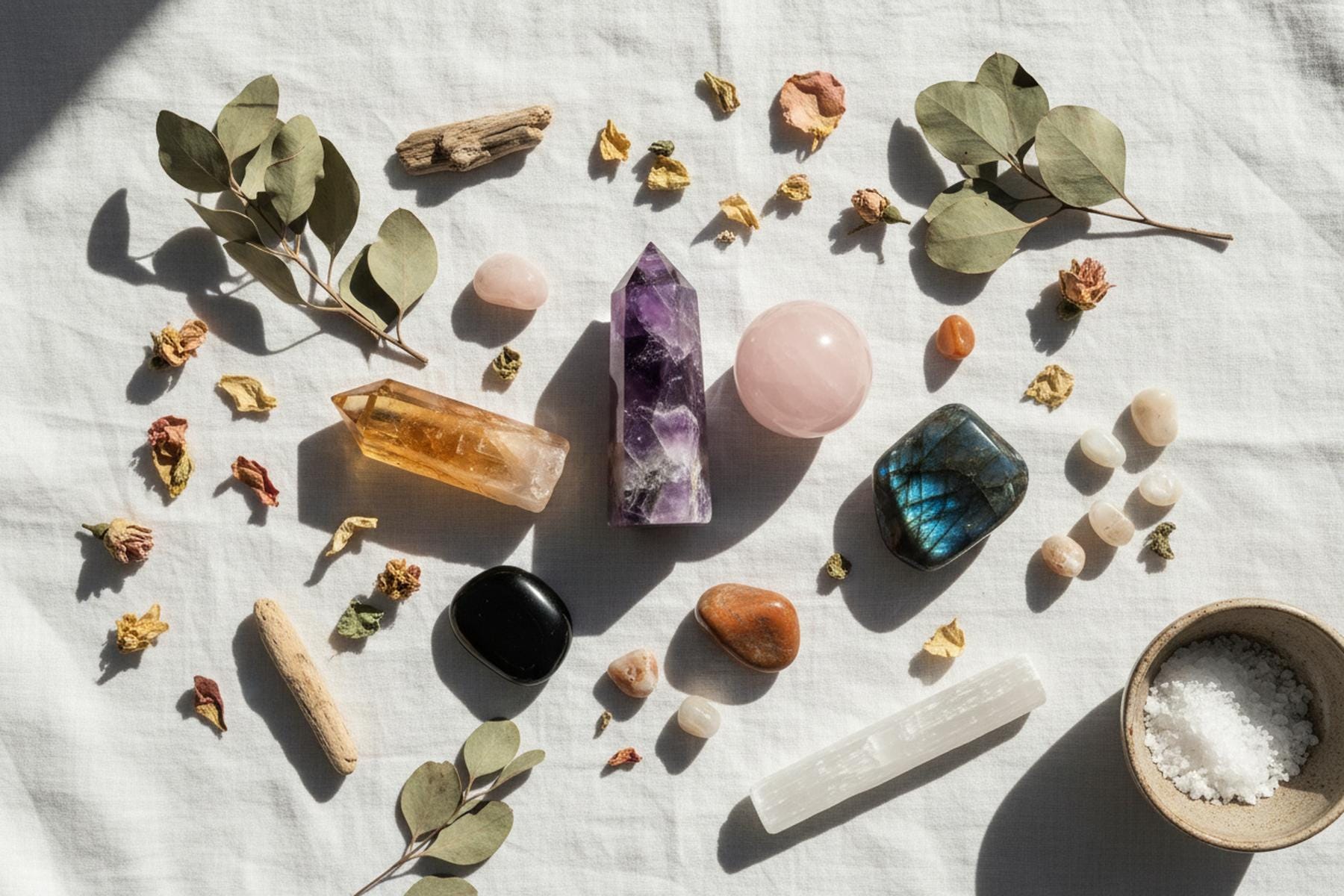
From deep purple amethyst to brilliant green malachite, the mineral world is bursting with color. But have you ever wondered why one crystal is blue while another is pink, or how a seemingly ordinary mineral can develop an extraordinary rainbow shimmer? The answer lies in chemistry, crystal structure, light, and sometimes a few microscopic surprises.
Color is more than decoration in the mineral world. It can tell us something about how a specimen formed, what elements are present, and even what happened to it during its geological journey.
The Science of Seeing Color
A crystal doesn't simply contain a little bottle of purple or green pigment. Its color comes from the way light interacts with its chemical composition and internal structure.
White light contains a mixture of visible wavelengths. When light reaches a mineral, certain wavelengths may be absorbed while others are reflected or transmitted. The wavelengths that reach our eyes determine the color we perceive.
Think of it as a tiny geological filter. A mineral that absorbs much of the red and yellow light may appear blue or green, while one that absorbs other portions of the spectrum may appear red or purple.
The fascinating part? Several completely different processes can create these colors.
Trace Elements: Tiny Ingredients, Big Color
Some of the most beautiful mineral colors are created by small amounts of elements that are not part of the mineral's main chemical formula. These are called trace elements or impurities, and even tiny quantities can make a dramatic difference.
Iron, chromium, manganese, copper, and cobalt are among the elements that contribute to mineral coloration.
Consider beryl, a mineral family with some particularly famous members. Emerald is green, aquamarine is blue, and morganite is pink. Their different colors are associated with different trace elements and chemical conditions within the crystal structure.
One especially interesting example is chromium. Small amounts of chromium can create the red of ruby and the green of emerald. Both gemstones belong to different mineral species, and their surrounding crystal structures influence how chromium interacts with light.
In other words, the same coloring element can produce very different results depending on its geological surroundings!
When a Crystal's Imperfections Create Its Beauty
Not every mineral gets its color from trace elements alone. Sometimes the secret lies in tiny imperfections within the crystal's atomic structure.
These imperfections can create what scientists call color centers. They occur when atoms or electrons are displaced, missing, or otherwise arranged differently from their usual positions. These changes affect how the crystal absorbs light.
Quartz gives us two wonderful examples.
- Amethyst's purple color is associated with iron within the quartz structure and radiation-related changes that create color centers.
- Smoky quartz develops its brown to nearly black appearance through a different radiation-related process involving aluminum impurities and changes in the crystal structure.
So the next time you admire a smoky quartz point or a purple amethyst cluster, remember that some of its color story was written at the atomic level!
Inclusions: A Little Color Within a Color
Sometimes the mineral itself isn't responsible for everything you see. Tiny particles of other minerals can become trapped inside a specimen, creating beautiful color variations.
For example, green chlorite inclusions can give quartz attractive green patches or wispy patterns. Hematite, an iron oxide mineral, can contribute reddish tones to materials such as jasper, feldspar, and calcite.
These inclusions can create landscapes, clouds, streaks, and intricate patterns that make natural specimens wonderfully individual. They are also a reminder that minerals rarely develop in complete isolation. Their surroundings can become part of their story.
Nature's Light Show: Opal and Iridescent Minerals
Some of the most captivating mineral colors are not produced by ordinary chemical coloration at all. They come from the way light interacts with extremely fine internal structures.
Precious opal is a spectacular example. Its characteristic play-of-color is produced by light interacting with tiny, regularly arranged silica spheres. The resulting optical effects separate and reinforce different wavelengths, creating flashes of green, blue, orange, and other colors as the viewing angle changes.
Certain feldspars also display beautiful optical effects. Moonstone, for example, can show a soft floating glow, while labradorite is admired for its flashes of blue, green, gold, and other colors. These effects are related to very fine internal structures within the feldspar.
Unlike a simple surface coating, these optical displays come from the way light interacts with the material itself.
Can Color Tell You What a Crystal Is?
Color can be a helpful clue, but it should never be the only method used to identify a mineral.
Different minerals can share nearly identical colors, and the same mineral can occur in many different shades. Fluorite, for example, can be purple, green, blue, yellow, or colorless. Quartz also appears in a remarkable range of colors and varieties.
Mineral identification involves looking at several properties together, including hardness, streak, luster, cleavage, crystal habit, transparency, and specific gravity. Even then, some specimens require professional testing for a confident identification.
It's also worth remembering that a specimen's appearance may be affected by treatments such as dyeing, heating, or irradiation. A treated stone isn't automatically undesirable, but accurate descriptions should distinguish natural color from known treatments whenever that information is available.
Every Color Has a Geological Story
One of the joys of collecting crystals and minerals is discovering that beauty and science are often intertwined. A purple crystal may owe its color to microscopic changes in its structure. A green gemstone may contain only a trace amount of a particular element. A rainbow flash may come from light interacting with structures far too small for our eyes to see.
Every specimen has its own combination of chemistry, structure, and geological history. That's part of what makes natural minerals so endlessly interesting.
At Craven Crystals, we love celebrating both the beauty of these natural treasures and the fascinating science behind them. Whether you're drawn to vibrant gemstones, unusual inclusions, or shimmering optical effects, there's always another little geological mystery waiting to be discovered. Explore more of our crystal and mineral articles and let your curiosity lead the way!