A crystal may look tough, feel substantial in your hand, and sparkle like it could survive just about anything. But appearances can be deceiving in the mineral world! Some beautiful stones scratch surprisingly easily, while others resist scratches but can still chip or break if dropped.
That's where the Mohs hardness scale comes in. If you've ever wondered what a mineral's hardness number actually means, or whether a higher number makes a crystal indestructible, you're in the right place.
What Is the Mohs Hardness Scale?
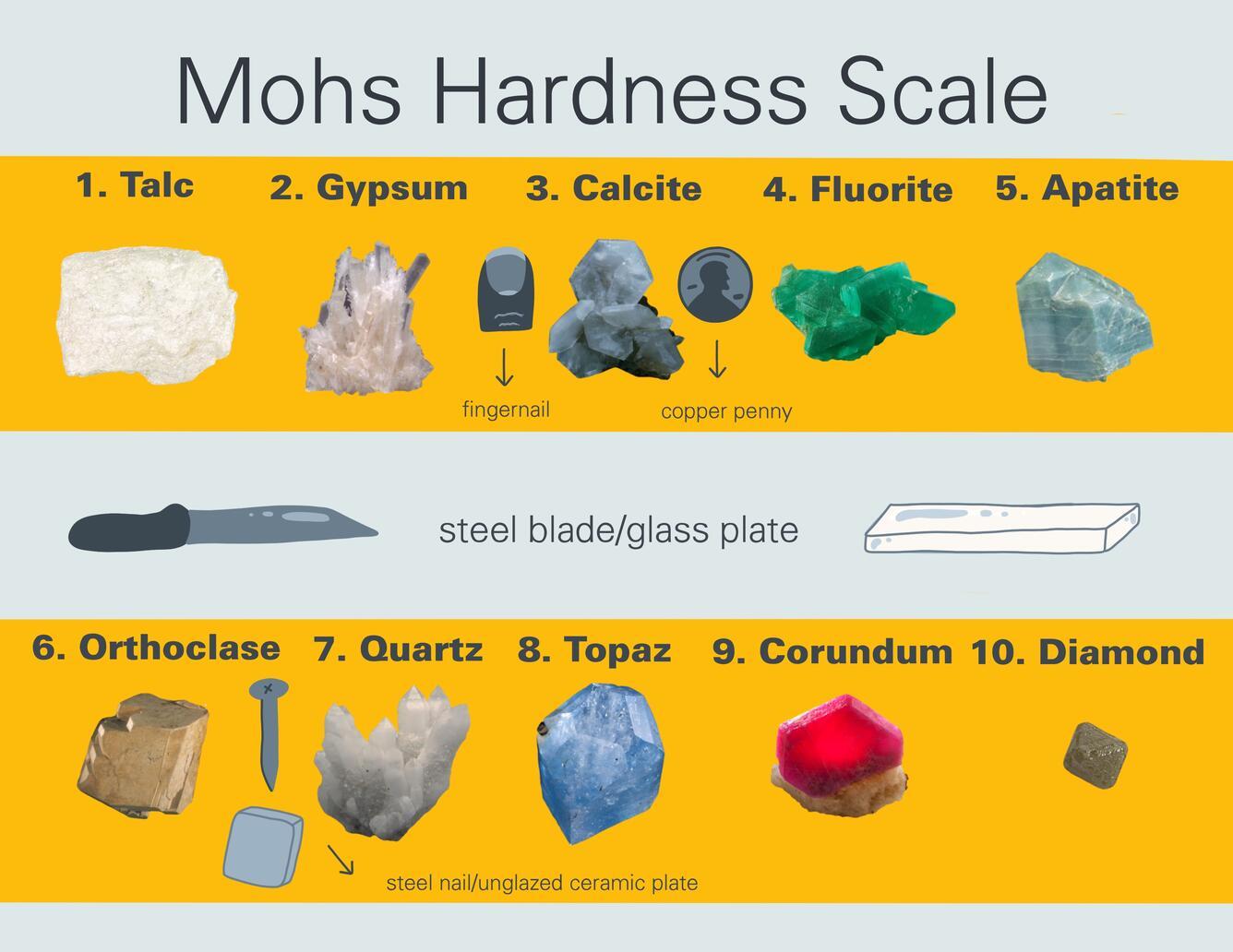
The Mohs hardness scale is a system used to compare how resistant minerals are to scratching. Developed by German mineralogist Friedrich Mohs in the early nineteenth century, it ranks ten reference minerals from 1, the softest, to 10, the hardest.
The principle is simple: a mineral that can scratch another mineral is harder than the material it scratches. The scale remains a popular tool for mineral identification because it offers a practical way to compare specimens.
Here are the ten reference minerals:
RatingMineral
- Talc
- Gypsum
- Calcite
- Fluorite
- Apatite
- Orthoclase feldspar
- Quartz
- Topaz
- Corundum (ruby and sapphire)
- Diamond
One important detail: the scale is relative, not linear. The difference between 9 and 10 is much greater than the difference between 1 and 2. Diamond is considerably harder than corundum, even though it is only one number higher.
What Does Hardness Mean for Your Crystals?
Hardness measures resistance to scratching and abrasion. It does not measure how heavy, strong, or difficult to break a stone is.
For example, quartz has a Mohs hardness of 7, making it harder than many common minerals. Amethyst, rose quartz, and clear quartz are all varieties of quartz, so they share that basic hardness rating.
Moonstone, by comparison, falls around 6 to 6.5. It is more vulnerable to scratching, and its internal cleavage directions make it susceptible to breaking from a hard impact.
This matters when choosing jewelry, arranging a mineral display, or storing a collection. Harder stones can scratch softer ones when they rub together, so tossing every specimen into one container is not always the best idea.
Hardness Isn't the Same as Toughness
Here's where mineral science gets particularly interesting.
Hardness is resistance to scratching. Toughness describes how well a material resists breaking, chipping, or cracking. A stone can score highly in one category without being equally impressive in the other.
Diamond is the classic example. It ranks 10 on the Mohs scale and is exceptionally resistant to scratching, but it can still chip or fracture when struck in the wrong direction.
Moonstone offers a different example. Its moderate hardness is only part of its durability story. Its cleavage, which describes directions along which a mineral can split more easily, makes it more vulnerable to certain impacts.
Gemologists also consider stability, meaning how a gemstone responds to environmental conditions such as heat, light, chemicals, and humidity. These three properties together provide a much better picture of durability than a hardness number alone.
Should You Test Your Crystals at Home?
Scratch testing can help narrow down the identity of an unknown mineral. Common reference materials include a fingernail, a copper coin, a steel nail, and glass. The National Park Service lists approximate hardness values of 2.5 for a fingernail, 3.5 for a copper penny, and 5.5 for a knife or glass plate.
However, there's an important collector's rule: don't scratch-test a finished gemstone, polished carving, valuable specimen, or piece of jewelry just to satisfy curiosity. You could permanently damage its surface.
If you are studying an expendable rough specimen, testing should be done carefully on an inconspicuous area with appropriate reference materials. A mark can sometimes be transferred material rather than an actual scratch, so results need to be examined rather than assumed.
Hardness is also only one clue. Mineral identification should consider other properties, including color, streak, luster, cleavage, crystal shape, and specific gravity.
A Few Simple Ways to Protect Your Collection
Understanding hardness can make a noticeable difference in caring for your crystals.
Store specimens separately when possible, particularly when combining harder and softer minerals. Small fabric pouches, individual compartments, and padded display spaces can help prevent pieces from rubbing against one another.
Be mindful of jewelry, too. Softer stones may benefit from settings that protect their edges, and pieces worn on the hands generally experience more bumps and contact than pendants or earrings.
Finally, remember that hardness does not tell you which cleaning method is safe. Some minerals are sensitive to heat, chemicals, or sudden temperature changes. Moonstone, for example, should be cleaned with warm soapy water rather than ultrasonic or steam cleaners.
Always consider the specific mineral before choosing a cleaning method.
A Little Knowledge Goes a Long Way
The Mohs scale is a small but mighty tool in the world of crystals. It helps explain why some minerals keep their polished shine more easily, why others need gentler handling, and why even the hardest gemstone isn't completely immune to damage.
At Craven Crystals, we believe that understanding the science behind a specimen makes collecting even more rewarding. Every crystal has its own combination of beauty, structure, and durability, and learning those details helps you appreciate each one a little more.
The next time you add a new treasure to your collection, take a peek at its Mohs rating. That little number might tell you more than you expect!