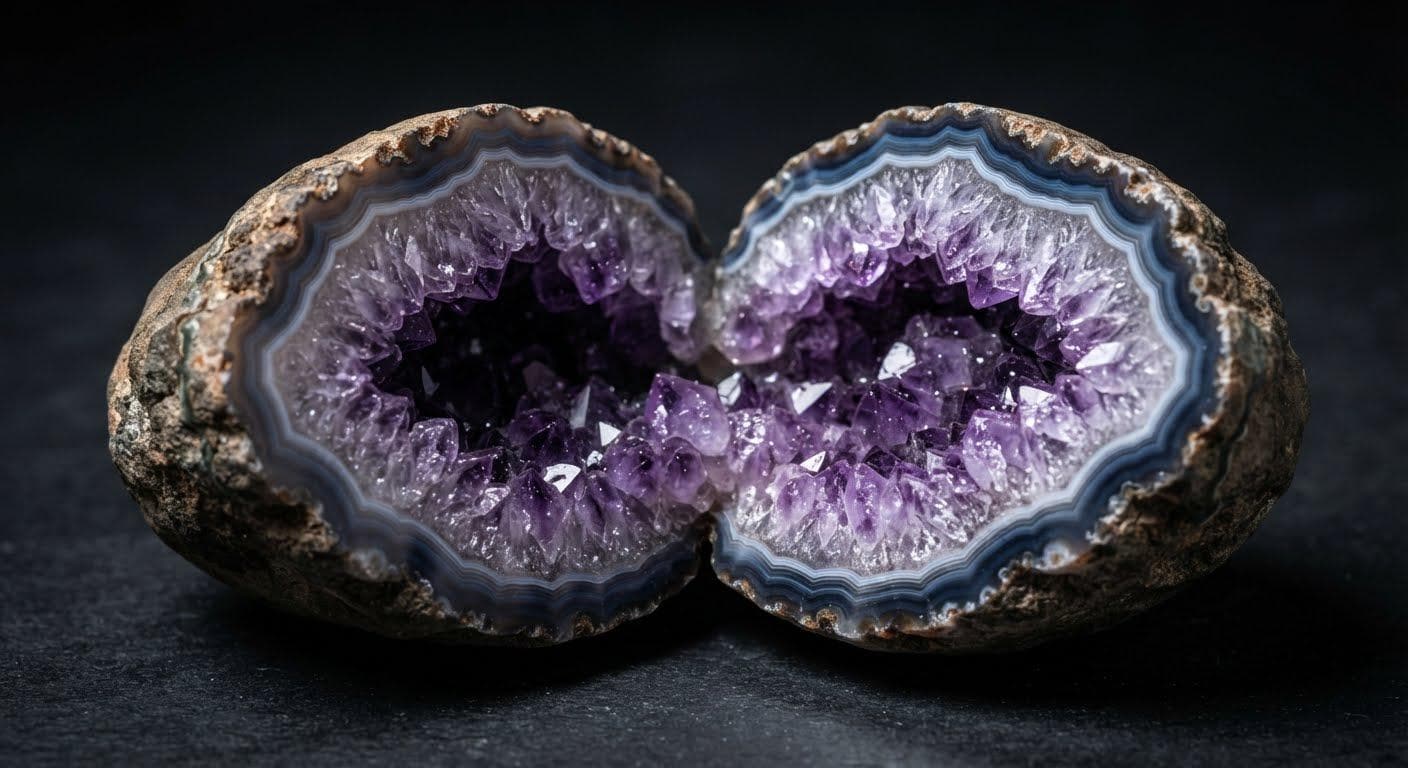
Have you ever picked up a plain, lumpy rock and wondered what might be hiding inside? Geodes are among the most delightful surprises in the mineral world. Their rough, unassuming exteriors can conceal sparkling quartz crystals, delicate calcite formations, colorful agate bands, and sometimes unusual mineral combinations. But how does a hollow rock become a tiny crystal-lined treasure chest?
The answer involves groundwater, dissolved minerals, chemistry, and an extraordinary amount of time.
What Exactly Is a Geode?
A geode is a rounded or irregular rock containing a cavity lined with mineral crystals or layered mineral deposits. Many have an outer shell made partly of chalcedony, a fine-grained form of quartz, while the inside may contain quartz crystals, amethyst, calcite, or other minerals.
Not every geode is completely hollow. Some are partially filled, while others become entirely filled with minerals over time. The crystals generally grow inward from the walls of the cavity, creating the familiar sparkling interior collectors love.
How Does a Geode Form?
Geodes can develop in different geological environments, but two common settings are sedimentary rocks and volcanic rocks.
In sedimentary environments, cavities can develop through the dissolution of minerals or organic material within buried sediments. In some well-studied geode deposits, the formation process is more complicated, involving mineral replacement and changes in the chemistry of groundwater.
In volcanic rocks, gas bubbles can become trapped as lava cools and hardens. These openings, called vesicles, provide spaces where minerals may later grow.
Once a cavity exists, mineral-rich groundwater can seep through tiny openings and fractures in the surrounding rock. As the water moves, it carries dissolved substances such as silica and calcium. Changes in the water's chemistry and conditions can cause those substances to precipitate, or separate from the water, and settle along the cavity walls.
Layer by layer, mineral deposits build up. If conditions allow, crystals begin growing inward into the open space. This process can continue over very long periods, eventually producing the beautiful interior of a geode.
What Creates the Crystals Inside?
Quartz is one of the most common minerals found in geodes. It can appear as clear or milky crystal points, and when certain trace elements and natural conditions are present, purple amethyst may develop.
Chalcedony often forms a smooth or banded layer beneath the crystals. Its colors and patterns can vary depending on mineral impurities and the conditions during formation.
Other geodes may contain calcite, dolomite, barite, celestite, or combinations of minerals. The exact contents depend on the chemistry of the fluids, the surrounding rock, and the geological history of the deposit.
This is why two geodes from the same general region can look remarkably different once opened. Nature doesn't work from a single mold!
Geodes, Agates, and Concretions: What's the Difference?
These three geological terms are sometimes confused, but they describe different structures.
A geode contains a cavity lined with crystals or mineral deposits. The open space is an important part of its identity, even if it is only partially hollow.
An agate is a banded variety of chalcedony. It may form as layers of silica accumulate inside a cavity, and it can occur within a geode. Not every agate is a geode, and not every geode contains visible agate banding.
A concretion is generally a solid, rounded mass formed when minerals cement sediment around a central point or nucleus. Some geodes and solid nodules have complicated formation histories, so the distinction is not always obvious from an exterior photograph.
Can You Tell What's Inside a Geode Before Opening It?
That is part of the fun, but unfortunately, there is no dependable way to know exactly what a geode contains just by looking at its outside.
A rough, bumpy surface may offer clues, and the geological location can help collectors make educated guesses. However, appearance alone cannot guarantee that a specimen is hollow, filled with quartz, or lined with a particular mineral.
Some geodes are completely solid. Others contain only a small cavity or a thin layer of crystals. Even experienced collectors can be surprised!
If you plan to open a geode, use appropriate eye protection and proper tools, or have it professionally cut. Hammering can send sharp rock fragments flying, and a clean cut often reveals the interior more clearly.
Why Geodes Are So Special to Collectors
Geodes are more than decorative mineral specimens. They are tangible examples of geological processes that are otherwise difficult to witness. Each one preserves a little record of the fluids, minerals, and conditions that existed underground long before it reached the surface.
For collectors, they also offer variety. Some display delicate crystal points, others showcase dramatic color contrasts, and some reveal intricate layers that look almost like miniature landscapes.
Whether you enjoy them for their geological story, their natural beauty, or the excitement of discovering what's inside, geodes remind us that a rock doesn't need a sparkling exterior to hold something extraordinary.
At Craven Crystals, we believe learning about the natural world makes every specimen more meaningful. The next time you admire a geode, take a moment to appreciate the remarkable journey that created it. That little crystal-lined chamber may have taken an astonishing stretch of Earth's history to become what you see today.