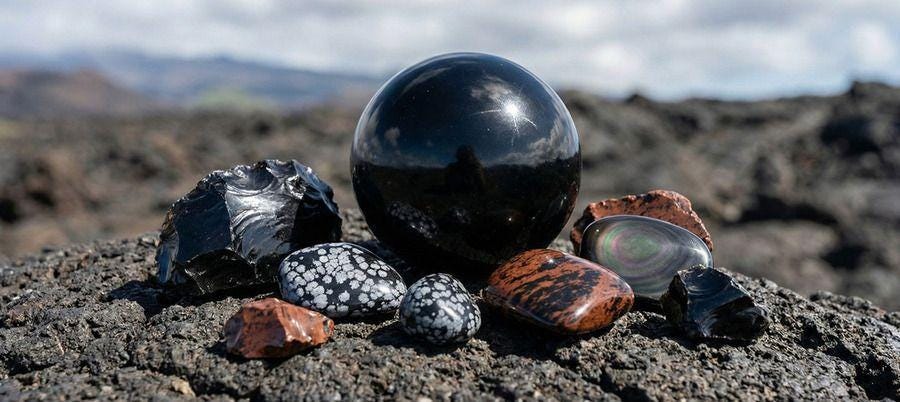
Glossy, mysterious, and often beautifully patterned, obsidian has a way of catching the eye. Its deep black shine can resemble polished onyx, while varieties with silvery flashes or delicate white markings look almost otherworldly. But unlike most of the crystals and minerals collectors admire, obsidian begins its life as molten volcanic material that cools before crystals have time to grow.
It's a beautiful reminder that the natural world doesn't always follow the rules we expect!
What Is Obsidian?
Obsidian is a naturally occurring volcanic glass, usually dark in color and glassy in appearance. It is an igneous rock formed from lava, most commonly silica-rich rhyolitic material.
Here's the interesting distinction: obsidian is not technically a mineral. Minerals have an organized internal atomic structure, but obsidian is amorphous, meaning its atoms do not form the regular repeating crystal arrangement found in minerals such as quartz or calcite.
That doesn't make it any less fascinating or collectible. It simply gives obsidian its own place in the geological family tree. The American Museum of Natural History and the U.S. Geological Survey both describe it as volcanic glass formed when lava cools rapidly.
How Does Molten Lava Become Glass?
Most rocks formed from cooling magma develop crystals as their molten material gradually solidifies. The atoms have time to arrange themselves into orderly structures, creating minerals.
Obsidian forms when the cooling process happens too quickly for that arrangement to take place.
Its parent material is typically silica-rich and highly viscous, meaning it is thick and resistant to flowing. When it erupts as lava and cools rapidly, crystal growth is inhibited and the material solidifies into glass instead.
This process also explains obsidian's distinctive fracture. Rather than breaking along the flat cleavage planes found in some minerals, it often breaks in smooth, curved surfaces known as conchoidal fractures. These fractures can produce exceptionally sharp edges.
Nature, it turns out, is quite capable of making its own cutting tools!
Is Obsidian Always Black?
Black is the color most people associate with obsidian, but nature offers more variety than that.
Depending on its composition and internal features, obsidian can occur in shades of brown, reddish brown, gray, green, and other colors. Some varieties display striking patterns or optical effects.
A few familiar examples include:
- Black Obsidian: The classic glossy, dark volcanic glass.
- Mahogany Obsidian: Recognized for its dark brown and reddish-brown patches.
- Snowflake Obsidian: Usually black with distinctive white or gray snowflake-like markings created by small mineral crystal formations within the glass.
- Sheen and Rainbow Obsidian: Varieties prized for their subtle metallic-looking or colorful flashes when viewed under suitable lighting.
The American Museum of Natural History notes that obsidian can occur in several colors and that snowflake obsidian contains small white crystals.
As always, color and appearance alone are not enough to confirm a specimen's identity. Natural variations, treatments, and manufactured glass can sometimes look similar, so reliable identification and accurate seller descriptions matter.
Obsidian's Remarkable Role in Human History
Long before obsidian became a popular material for polished carvings and jewelry, people valued it for something much more practical: its ability to produce sharp cutting edges.
For thousands of years, communities around the world worked obsidian into blades, knives, spear points, and other tools. The process of shaping it by carefully striking away flakes is known as knapping. Its sharp fracture edges made it particularly useful for cutting and hunting tools.
Obsidian also tells fascinating stories about ancient trade and travel. Researchers can analyze the trace-element composition of obsidian to help identify the volcanic source from which it originated. This allows archaeologists to connect artifacts found far from their geological birthplace with the regions where the material was collected.
The U.S. Geological Survey reports that obsidian from Yellowstone's Obsidian Cliff was traded as far away as Ohio and Canada. Idaho National Laboratory has also described how chemical signatures help researchers investigate ancient movement and trade routes.
A small piece of volcanic glass can carry an astonishing amount of human history!
Caring for Obsidian
Although obsidian has a substantial appearance, it is brittle and can chip or break when struck. Its glassy surface can also become scratched, so it deserves a little extra care.
For polished pieces and jewelry, gentle cleaning with a soft cloth and mild soapy water is generally a sensible approach. Avoid rough scrubbing, harsh chemicals, and sudden impacts. Store obsidian separately from harder stones to reduce the chance of scratches.
If a piece breaks, remember that freshly fractured obsidian can have extremely sharp edges. Handle damaged specimens carefully rather than picking them up with bare fingers.
A Little Volcanic History to Treasure
Obsidian is a wonderful example of how different geological processes can create materials with very different appearances and properties. It may not have the orderly crystal structure of quartz or amethyst, but its volcanic origins, distinctive patterns, and remarkable history make it every bit as interesting to explore.
At Craven Crystals, we love discovering the stories behind the materials we collect and create with. Whether you're drawn to classic black obsidian, snowy patterns, or shimmering varieties, there's always more to learn about these natural treasures.
The next time you admire a polished piece of obsidian, remember: you're looking at a little snapshot of volcanic history, cooled into glass and shaped by time.