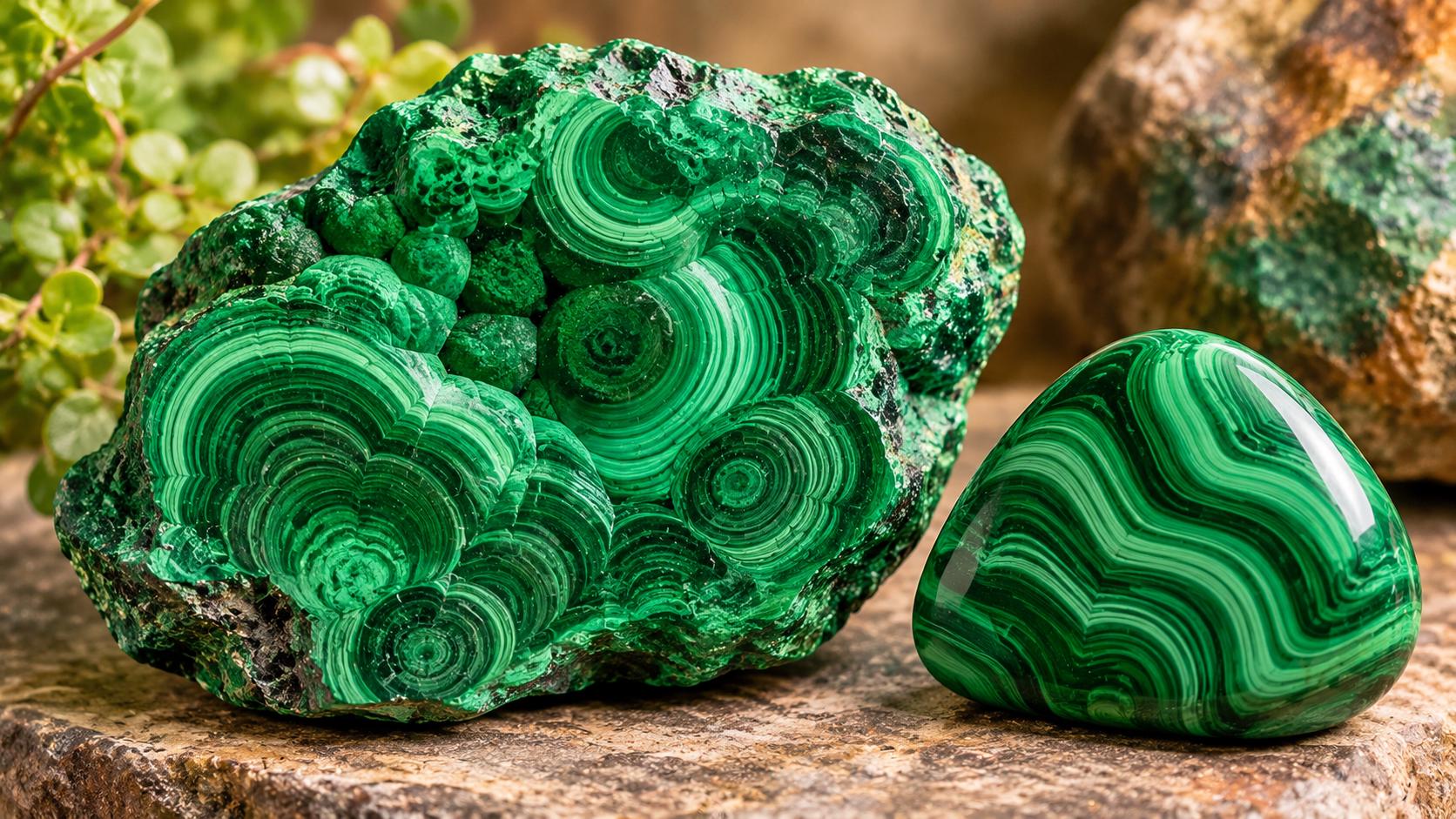
Some crystals catch your eye with sparkling points, while others win you over with color. Malachite manages to do both, even without the sparkle! Its rich shades of emerald, forest, and mint green form beautiful swirling bands that can resemble tiny landscapes, tree rings, or abstract works of art. But these patterns aren't painted on. They're part of the mineral's geological story.
Behind malachite's distinctive appearance is a fascinating combination of copper chemistry, groundwater, and slow mineral growth. Let's explore how this remarkable green treasure forms and why no two pieces look exactly alike.
What Is Malachite?
Malachite is a naturally occurring copper carbonate hydroxide mineral with the chemical formula Cu₂CO₃(OH)₂. Its unmistakable green color comes from copper within its chemical structure.
Unlike minerals that commonly form large, well-defined crystal points, malachite is usually found in massive, fibrous, or rounded formations. It can develop as smooth crusts, delicate radiating fibers, grape-like clusters, and beautifully banded masses.
With a Mohs hardness of approximately 3.5 to 4, malachite is relatively soft compared with quartz, which measures 7. This softness allows it to be shaped and polished into decorative objects, beads, cabochons, and carvings, although it also means the material requires thoughtful handling.
How Does Malachite Form?
Malachite is considered a secondary mineral because it develops through the alteration of existing copper-bearing minerals.
It commonly forms in the oxidized portions of copper deposits, where oxygen-rich groundwater interacts with copper-bearing rocks. As water moves through fractures and cavities, it can dissolve and transport copper. When the surrounding chemical conditions are suitable, copper combines with carbonate and hydroxide components, allowing malachite to precipitate.
Over time, successive episodes of mineral deposition can create layers of different green shades. Variations in the chemistry of the groundwater and the conditions during growth contribute to the intricate banding that makes malachite so recognizable.
Malachite is frequently found alongside other copper minerals, particularly azurite, a striking blue mineral with its own beautiful color story. In some specimens, the two occur together, creating a natural combination of brilliant blue and green often called azurmalachite.
Why Does Malachite Have Those Beautiful Bands?
One of malachite's most recognizable features is its concentric banding. These patterns can form through repeated mineral growth, sometimes producing rounded rings, sweeping curves, and alternating shades of light and dark green.
Depending on the specimen's growth habit, the patterns may look like ripples, eyes, waves, or miniature topographical maps.
Malachite can also develop a formation called botryoidal growth. The word comes from the Greek word for a bunch of grapes, which describes the rounded, clustered appearance of the mineral's surface.
Other specimens develop stalactitic formations, where mineral deposits build up in elongated, layered structures around a central core. When cut across these formations, the resulting patterns can reveal beautiful circular or concentric designs.
These natural variations are part of what makes malachite so appealing to collectors. Its patterns are not simply surface decoration. They are physical records of the conditions under which the mineral developed.
Malachite Throughout History
Malachite has been appreciated by people for thousands of years, long before it became a popular material for modern jewelry and crystal collections.
Ancient civilizations valued its vivid green color for ornamental objects and mineral pigments. Historical uses included decorative inlays, carvings, and finely ground green pigment used in artistic applications.
Ancient Egypt is particularly associated with malachite, where green mineral pigments were used in cosmetics and decoration. Its rich color also made it desirable for artistic and ceremonial objects.
During the nineteenth century, large deposits in Russia's Ural Mountains supplied malachite for elaborate decorative works. One famous example is the Malachite Room in the Winter Palace in St. Petersburg, where the mineral was used in impressive architectural and ornamental designs.
Its historical appeal is easy to understand. Malachite offers a natural green palette that is difficult to overlook, and its swirling patterns give even simple decorative pieces a distinctive appearance.
How Can You Recognize Natural Malachite?
Natural malachite is generally recognized by its green coloration and characteristic banding, but identifying a specimen requires more than simply looking for stripes.
Common characteristics include:
- Multiple shades of green, ranging from pale green to deep emerald and nearly black-green.
- Curved, concentric, or irregular banding.
- A relatively soft hardness of approximately 3.5 to 4 on the Mohs scale.
- A pale green streak when tested on an appropriate unglazed surface.
- A relatively high density for its size because of its copper content.
Imitations can be made from dyed materials, glass, plastics, or composite products. Some are designed to reproduce the familiar green banding quite convincingly.
Natural malachite often displays irregular growth patterns and variations in texture, but appearance alone cannot guarantee authenticity. When purchasing, look for accurate material descriptions and a seller who is transparent about whether a piece is natural, stabilized, dyed, or otherwise treated.
Caring for Your Malachite
Malachite deserves a little extra attention because it is softer and more sensitive to chemicals than many commonly collected minerals.
For polished pieces, use a soft cloth to remove dust and fingerprints. If necessary, a lightly dampened cloth can be used, followed by prompt drying. Avoid prolonged soaking, acidic cleaners, vinegar, and lemon juice, as acids can react with and damage the mineral.
Ultrasonic and steam cleaners should also be avoided. When storing malachite jewelry, keep it separate from harder stones that could scratch its surface.
One additional safety note: malachite contains copper, and dust produced during cutting, grinding, or sanding can be hazardous if inhaled. Those working with unfinished material should use appropriate lapidary safety precautions, including suitable respiratory protection and wet-working methods. Finished, polished pieces can generally be handled and displayed normally. Never grind or sand malachite casually at home, and never use it to prepare drinking water or crystal elixirs.
A Little Green Wonder Worth Appreciating
Malachite is a wonderful example of how geology can create something that looks almost artistically designed. Its intricate bands, rich colors, and fascinating history make it much more than an attractive green stone.
Whether you enjoy it for its mineral composition, its historical significance, or the natural patterns that make every specimen unique, malachite has plenty of stories to tell.
At Craven Crystals, we believe that learning about the materials behind our favorite treasures makes collecting even more rewarding. The next time you admire a piece of malachite, take a closer look at those swirling green bands. You're not just looking at a beautiful pattern. You're looking at a little record of Earth's chemistry, preserved in stone!