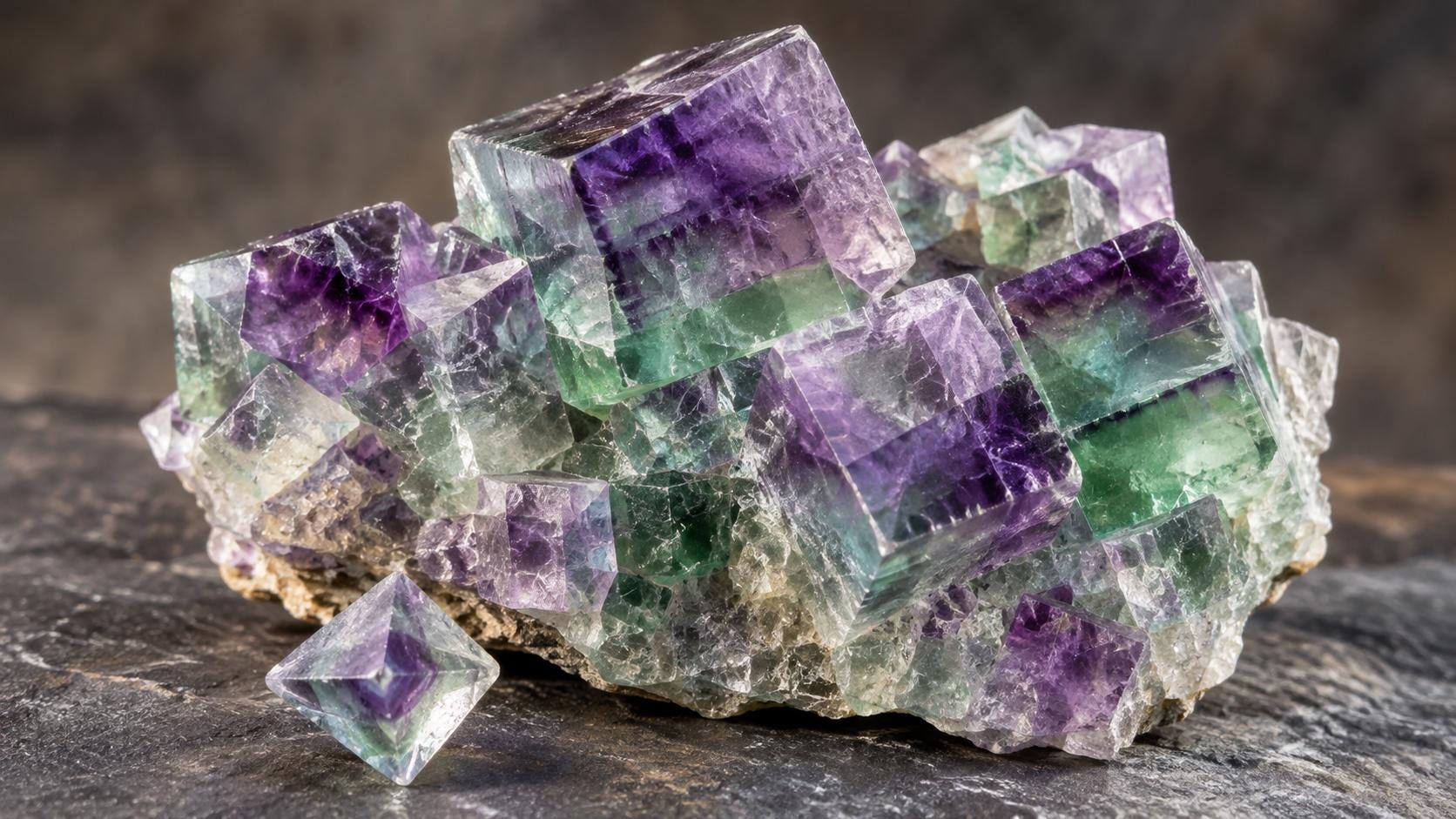
If minerals had personalities, fluorite would be the artist who arrives wearing six different colors, rearranges the furniture into perfect cubes, and then casually reveals that it can split itself into tiny geometric masterpieces. It's colorful, clever, and full of surprises.
Known for its beautiful purple, green, blue, yellow, and banded varieties, fluorite is a collector favorite. But behind those pretty colors is a mineral with an unusual crystal structure, a fascinating industrial history, and a starring role in the story of fluorescence.
A Rainbow With a Chemical Formula
Fluorite is a halide mineral composed of calcium and fluorine, with the chemical formula CaF₂. Pure fluorite is colorless, but trace impurities and structural defects can produce an extraordinary range of colors. Some crystals are a single shade, while others display dramatic bands or zones of purple, green, blue, yellow, and clear material.
Those color bands can record changes in the chemistry of the mineral-rich fluids as the crystal grew. Imagine a crystal keeping a geological diary, with each layer recording a different chapter of its underground life.
Fluorite commonly forms when hot, mineral-rich fluids move through fractures and cavities in rock, depositing minerals as conditions change. It is frequently found in veins associated with limestone and dolostone, sometimes alongside minerals containing lead, zinc, and other metals.
Cubes, Octahedrons, and a Very Good Reason to Love Geometry
Fluorite belongs to the cubic crystal system, and its most familiar natural crystal shape is, appropriately, a cube. Some specimens form beautifully sharp individual cubes, while others grow into clusters or develop combinations of different crystal faces.
It can also form octahedrons, which have eight triangular faces, and more complex shapes. But here's the real party trick: fluorite has perfect octahedral cleavage in four directions.
Cleavage is a mineral's tendency to split along particular internal planes where its atomic structure makes breaking easier. In fluorite, those planes can produce remarkably neat octahedral fragments. In other words, the crystal has built-in geometric exit routes!
This is also why attractive fluorite specimens deserve gentle handling. A sharp knock can turn a beautiful crystal corner into a missing piece.
The Mineral That Gave Us the Word "Fluorescence"
Here's a delightful piece of scientific trivia: the word fluorescence comes from fluorite.
Certain fluorite specimens glow when exposed to ultraviolet light. The glow is caused by energy absorbed by the mineral and then released as visible light. The exact response depends on the specimen's chemical makeup and internal defects. Some fluorite glows blue or violet, while other pieces may show different colors. Plenty of specimens don't fluoresce noticeably at all.
In the nineteenth century, scientist George Gabriel Stokes studied this phenomenon and introduced the term fluorescence in 1852, naming it after the mineral. The element fluorine was also named after fluorite. That's quite a legacy for one colorful rock!
And remember: a fluorite specimen doesn't need to glow under UV light to be genuine. Fluorescence is a possible property, not a universal membership requirement.
Blue John: Fluorite Fit for Royal Rooms
One particularly treasured variety is Blue John, a strikingly banded purple-blue, white, and sometimes yellowish fluorite found at Castleton in Derbyshire, England.
Blue John became popular as an ornamental stone during the eighteenth century. It was fashioned into decorative objects, vases, columns, and other elegant household pieces. The Oxford University Museum of Natural History records its discovery around 1700 and its use for ornamental work from approximately 1750 onward. Its distinctive color bands made it especially desirable for decorative craftsmanship.
Unlike ordinary fluorite, which occurs in many places around the world, the famous Blue John material is associated with a very limited area. It's a lovely reminder that a mineral's value can come from the uniqueness of its geological birthplace as much as its appearance.
Foolproof Identification? Not Quite!
Fluorite can sometimes be confused with amethyst, particularly when both are purple. A few clues help tell them apart. Fluorite has a Mohs hardness of 4, while quartz, including amethyst, measures 7. Fluorite commonly forms cubes and has distinctive octahedral cleavage; amethyst typically forms six-sided quartz crystals and does not share fluorite's cleavage.
Color alone is never enough for a confident identification, and hardness tests can damage a specimen. If you're unsure, compare crystal shape, cleavage, and reliable provenance rather than reaching for a pocketknife.
A Little Fragile, A Lot Fabulous
Fluorite's softness and cleavage make it less suitable for jewelry that receives daily knocks and bumps. It is best treated as a special-occasion stone or a carefully protected decorative piece. Keep it separate from harder minerals, avoid sudden temperature changes, and clean it gently with a soft cloth. Skip ultrasonic cleaners, steam cleaning, and harsh chemicals.
Beyond its scientific and decorative appeal, fluorite is associated in modern metaphysical traditions with clarity, focus, learning, and balance. These are symbolic beliefs rather than scientifically demonstrated effects, and interpretations vary among traditions and individuals.
Whether you're drawn to its rainbow colors, its remarkable crystal shapes, or its place in the history of science, fluorite has plenty to offer. It's proof that geology can be both wonderfully orderly and delightfully unpredictable.
Keep exploring the extraordinary stories behind Earth's natural treasures with Craven Crystals. After all, there's a whole underground gallery of wonders waiting to be discovered, and fluorite is only one of its many colorful masterpieces!