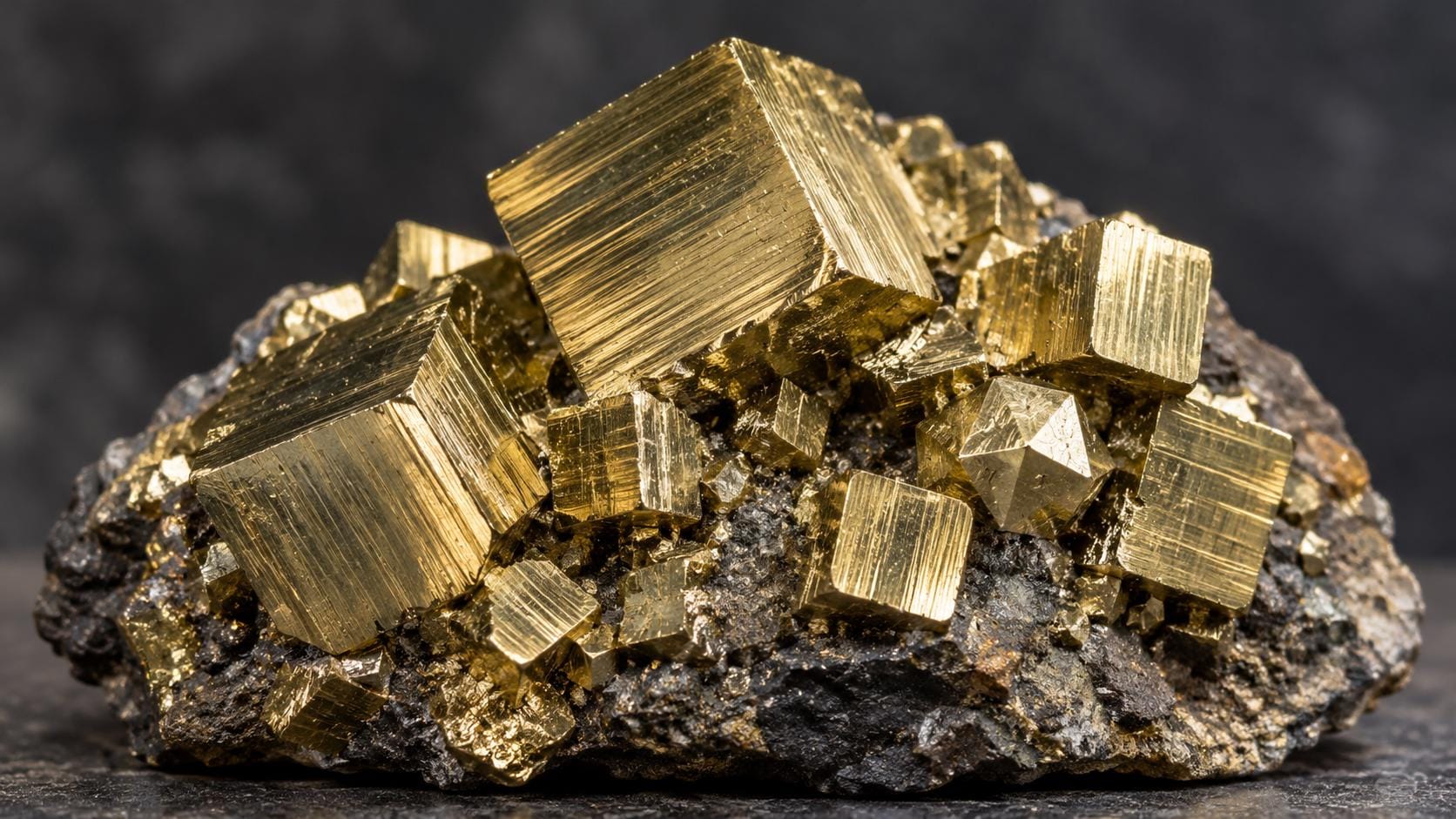
It sparkles like treasure, forms some of the most beautifully geometric crystals in the mineral world, and has fooled more than a few hopeful gold hunters. Meet pyrite, better known as fool’s gold. But calling it a fake version of something else hardly gives this remarkable mineral its due. Pyrite has a geological story all its own, and its golden personality comes with some surprisingly interesting science.
What Exactly Is Pyrite?
Pyrite is an iron sulfide mineral with the chemical formula FeS₂. It has a metallic luster and a distinctive brassy-yellow color that can look remarkably like gold, especially when light catches its reflective surfaces.
It is one of the most common sulfide minerals on Earth and occurs in many types of rock, including igneous, metamorphic, and sedimentary formations. Pyrite can develop in a wide range of geological environments, from hot mineral-rich fluids deep underground to oxygen-poor sediments on ancient sea floors.
Its name comes from the Greek word pyr, meaning fire. The name is fitting: when struck against certain hard materials, pyrite can produce sparks. Historically, this property made it useful for starting fires and later for producing sparks in flintlock firearms.
Nature's Little Geometry Lesson
One reason pyrite is such a favorite among mineral collectors is its crystal shape. Although many minerals form irregular masses or clusters, pyrite is famous for producing beautifully defined geometric crystals.
The most recognizable form is the cube, often with sharply defined edges and flat faces. Some cubes display fine, parallel grooves called striations. These natural lines are part of the crystal's growth pattern and give the surfaces a distinctive texture.
Pyrite can also form octahedrons, which have eight triangular faces, and pyritohedrons, which have twelve pentagonal faces. Some specimens grow as tiny rounded clusters known as framboids. The name comes from the French word framboise, meaning raspberry, because these microscopic aggregates can resemble little mineral berries. Framboidal pyrite is often found in organic-rich sediments.
A specimen with a well-formed cube or an unusual combination of crystal shapes can be every bit as captivating as a colorful gemstone. Sometimes geometry really is the main attraction.
Why Is It Called Fool's Gold?
Pyrite earned its nickname because its metallic shine and yellow color can resemble native gold. However, the two minerals behave very differently.
Pyrite has a Mohs hardness of approximately 6 to 6.5, while gold is much softer, around 2.5 to 3. Pyrite is brittle and tends to fracture; gold is malleable and can bend or flatten. Pyrite also leaves a greenish-black to brownish-black streak, while gold leaves a yellow streak. Gold is dramatically denser, too, so a similarly sized piece feels much heavier.
One interesting twist: pyrite and gold can occur together in the same deposits. In some locations, tiny amounts of gold are actually contained within pyrite. So while a shiny pyrite cube is not itself a gold nugget, the mineral can sometimes be part of a genuine gold-bearing deposit.
A word for curious rockhounds: streak and hardness tests can damage a specimen. Avoid testing attractive or valuable pieces, and never assume color alone confirms an identification.
The Less Glamorous Side of Pyrite
Pyrite's relationship with oxygen and moisture is important. When exposed to air and water, it can oxidize. In natural environments and mining areas, this reaction can contribute to acidic drainage that affects surrounding water and ecosystems.
This same tendency is worth remembering when caring for a collection. Some pyrite specimens remain stable for many years, while others can tarnish, develop coatings, or deteriorate under unsuitable storage conditions. Keep specimens dry, avoid prolonged humidity, and do not soak them or clean them with household chemicals. If a piece develops unusual powdery deposits or begins breaking down, keep it separate from neighboring specimens and seek advice from an experienced mineral conservator or dealer.
Pyrite in Crystal Traditions
Beyond its geological appeal, pyrite has a place in modern crystal and metaphysical traditions. It is commonly associated with abundance, confidence, motivation, and protection. These associations are symbolic beliefs rather than scientifically established effects, and interpretations vary among traditions and individuals.
Whether you enjoy pyrite for its traditional symbolism or simply appreciate its brilliant metallic luster and remarkable crystal forms, it brings a little golden drama to a mineral collection.
Pyrite reminds us that a mineral doesn't need to be precious metal to be extraordinary. Its sharp cubes, sparkling surfaces, and fascinating geological history make it a treasure in its own right. Explore more of the natural colors, shapes, and stories behind Earth's minerals with Craven Crystals. There's always another little geological wonder waiting to catch your eye.