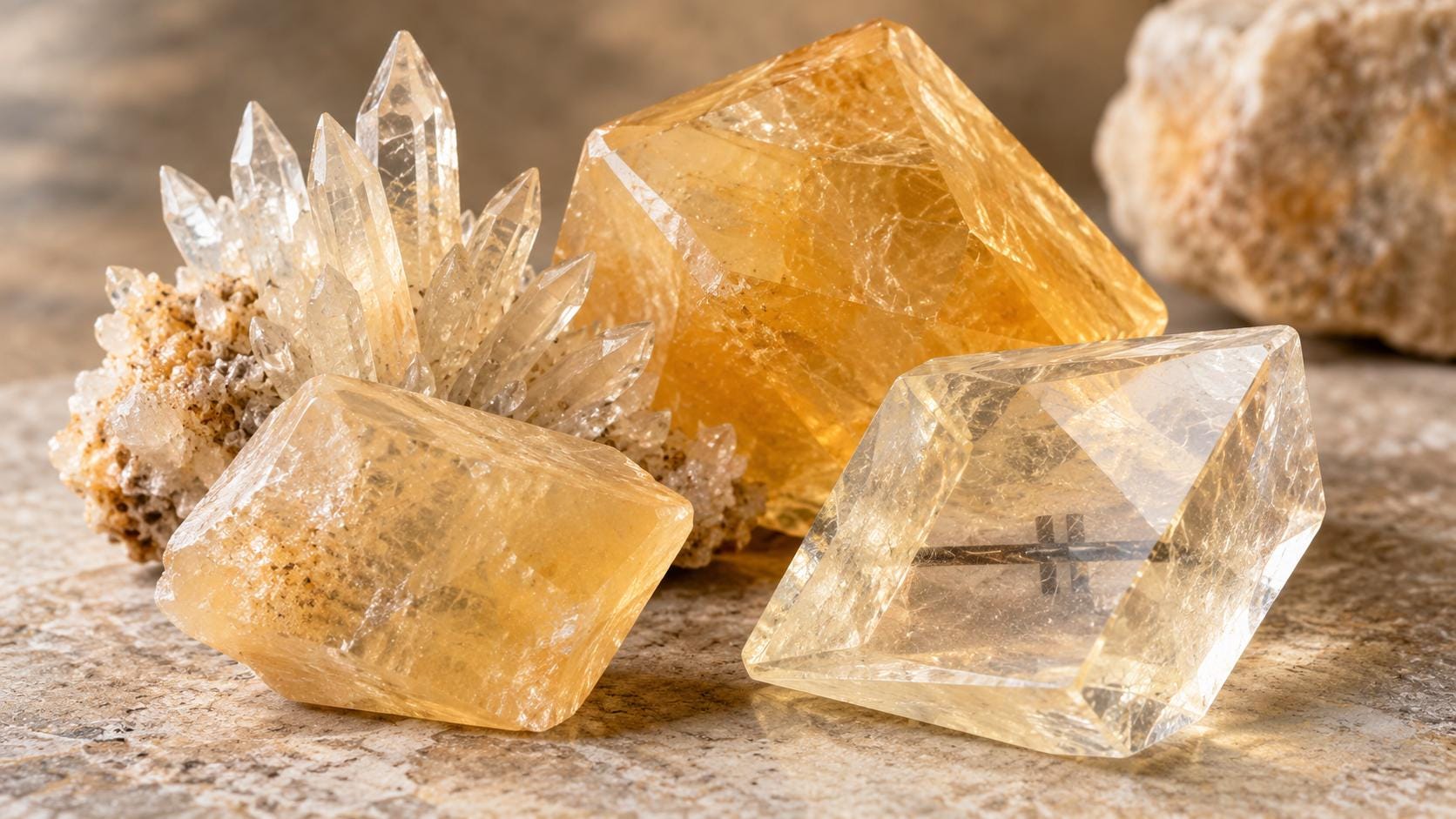
Some minerals earn attention with brilliant flashes of color or extraordinary crystal points. Calcite has a different talent: it is practically everywhere, yet it rarely looks the same twice. It can be clear as glass, golden as honey, pink as a rose petal, or arranged in dramatic clusters of pointed crystals. It can even make a printed line appear twice! This familiar mineral has a surprisingly impressive résumé, from building mountains to decorating underground caverns.
Meet Calcite: A Mineral with a Big Job
Calcite is a carbonate mineral with the chemical formula CaCO₃, meaning it is made primarily of calcium, carbon, and oxygen. It is one of Earth's most widespread minerals and occurs in many geological environments.
It is the principal mineral in limestone and marble, and it is also an important ingredient in many seashells and other marine organisms' hard parts. When calcium-rich water moves through underground rock, calcite can dissolve and later crystallize again. That process helps create the beautiful mineral formations found in caves, including stalactites hanging from ceilings and stalagmites rising from cave floors.
Calcite is also an important part of everyday human life. Limestone and marble have been used in buildings, sculptures, mortar, plaster, and cement for centuries. In other words, this mineral is not just sitting pretty in a display cabinet. It has helped build quite a bit of the world around us.
One Mineral, Countless Crystal Shapes
One of calcite's most fascinating qualities is its variety of crystal habits. A mineral's habit describes the shape or appearance it commonly develops as it grows.
Calcite can form chunky rhombohedrons, elongated crystals, delicate clusters, and pointed formations often nicknamed dogtooth calcite because their tapered shapes resemble little teeth. Some specimens grow in thin, stacked layers that collectors affectionately call poker-chip or potato-chip calcite.
These different shapes develop because crystal growth responds to the conditions surrounding it, including the chemistry of the mineral-rich fluid and the space available. The result is a remarkable range of forms, even though the underlying mineral remains calcite.
Color adds another layer of variety. Pure calcite is typically colorless or white, but trace elements and other impurities can contribute shades of yellow, pink, green, gray, and more. Manganese may contribute pink tones, copper can produce green, iron can create yellowish or golden colors, and cobalt can produce deeper pink to purple hues. Color alone, however, is not enough to identify the exact cause in an individual specimen.
The Crystal That Makes You See Double
Clear calcite has a particularly entertaining optical trick. A transparent variety known as Iceland spar displays a property called birefringence, also known as double refraction.
Light traveling through the crystal behaves in two different ways, producing two rays. When you place a clear piece of optical calcite over a printed line or small object, the image can appear doubled. It is not a flaw in your eyesight or a secret message hiding in the mineral. It is a real optical property caused by calcite's internal crystal structure.
This effect made Iceland spar important in the study of light and continues to make clear calcite fascinating to collectors and scientists alike.
How to Recognize Calcite
Calcite has a few useful identifying characteristics. Its Mohs hardness is approximately 3, so it is relatively soft compared with minerals such as quartz. It also has perfect cleavage in three directions, meaning it can break along natural planes of weakness to produce slanted, rhombohedral fragments.
Another familiar identification feature is its reaction with dilute acid. Calcite releases carbon dioxide bubbles when exposed to an appropriate acid. Even household vinegar can produce a reaction, although it is much weaker and may take longer to become noticeable.
A word of caution for collectors: hardness and acid tests can damage a specimen. Never apply acid to a treasured piece, polished carving, or jewelry, and avoid scratching a specimen just to satisfy curiosity. When identification matters, consult a knowledgeable mineral dealer or qualified geologist.
Calcite can also be confused with dolomite and aragonite. Aragonite has the same chemical formula as calcite but a different crystal structure. Dolomite can share similar colors and cleavage, but it generally reacts less readily to dilute acid unless powdered. Close examination and proper testing may be needed for a confident identification.
Caring for Your Calcite Collection
Calcite's beauty comes with a little fragility. Its relatively low hardness means it can scratch more easily than many popular display minerals, while its cleavage makes crystal points and edges vulnerable to knocks.
Give calcite its own space rather than letting it tumble against harder specimens. Use a soft brush or gentle dry cloth to remove dust, and avoid acidic cleaners, abrasive products, and aggressive cleaning methods. If a specimen has delicate surfaces, coatings, or unknown treatments, ask for care guidance before using liquids.
In modern crystal traditions, calcite is often associated with clarity, learning, energy, and personal growth. These are symbolic and metaphysical beliefs rather than scientifically established effects, and associations vary among traditions and individuals. Many collectors simply enjoy the mineral's beauty, geological story, or personal meaning.
Whether you are drawn to its unusual optical properties, its many crystal shapes, or the soft colors created by trace elements, calcite offers plenty to explore. Take a closer look at the mineral pieces and natural designs featured at Craven Crystals, and you may discover that this everyday geological workhorse deserves a very special place in your collection.