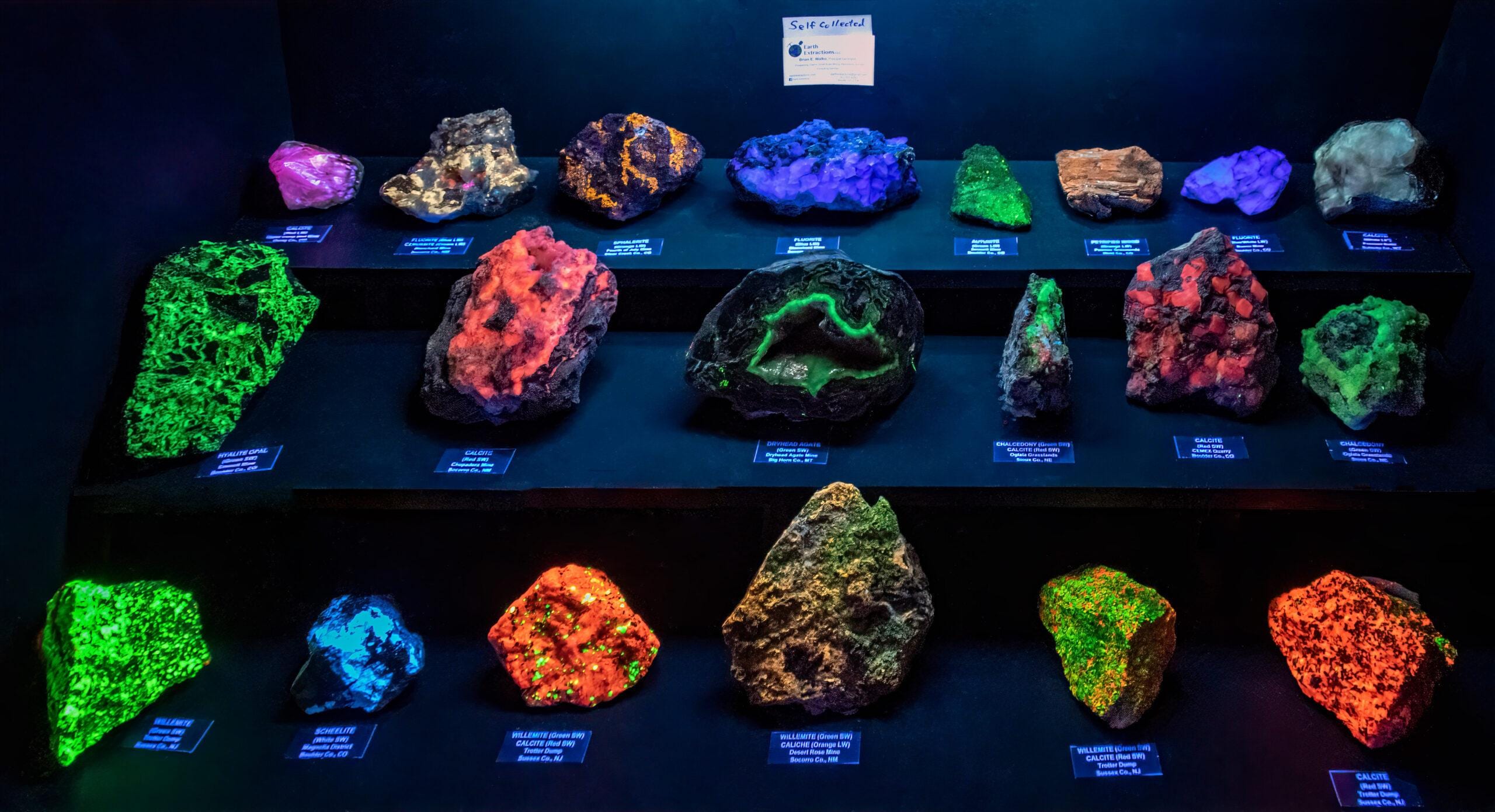
What if your crystal collection had a secret life after the lights went out? Some minerals that look perfectly ordinary in daylight transform into brilliant shades of neon green, electric blue, fiery orange, and glowing pink when exposed to ultraviolet light. No fairy dust required! Just a fascinating scientific phenomenon called fluorescence.
Fluorescent minerals are among the most entertaining specimens to explore because they reveal something our eyes normally cannot see. But why do certain rocks glow while others remain stubbornly unimpressed? The answer involves chemistry, atomic energy, and a little help from some very special trace elements.
What Is Mineral Fluorescence?
Fluorescence occurs when a material absorbs energy from ultraviolet (UV) light and almost immediately releases some of that energy as visible light.
Here's the simplified science: certain atoms or impurities within a mineral absorb ultraviolet radiation, causing electrons to move into higher energy states. When those electrons return to lower energy states, they release energy in the form of light that our eyes can see.
The resulting glow is fluorescence!The colors depend on the mineral's chemical composition, trace elements, crystal structure, and the wavelength of ultraviolet light being used.
Interestingly, not every specimen of a particular mineral will fluoresce. Two pieces of calcite from different locations might behave completely differently under the same UV lamp. One could glow brilliant pink while the other looks exactly as it did in daylight.
That's because tiny chemical differences can make an enormous difference in how a mineral responds to ultraviolet light.
Which Minerals Put on the Best Light Shows?
Several minerals are particularly well known for their fluorescent properties, although the colors and brightness can vary from specimen to specimen.
- Fluorite: One of the most famous fluorescent minerals. Certain specimens glow beautiful blue, violet, or other colors under UV light. The word fluorescence was actually named after fluorite!
- Calcite: A wonderfully unpredictable performer. Depending on its trace elements and geological origin, calcite can fluoresce pink, red, orange, yellow, blue, or even green.
- Willemite: This zinc silicate mineral is famous for its brilliant green fluorescence. Specimens from Franklin, New Jersey, are especially celebrated among fluorescent mineral collectors.
- Scheelite: A tungsten-bearing mineral that can produce a striking blue-white glow under ultraviolet light, particularly shortwave UV.
- Sodalite: Certain varieties, including material sold as hackmanite, can display beautiful orange, pink, or reddish fluorescence.
- Hyalite Opal: Some specimens produce an extraordinary bright green glow under UV light due to uranium-bearing components within the material.
And here's a fun collector's fact: the presence or absence of fluorescence is not always a reliable way to identify a mineral. It is an additional clue, not a guaranteed identification test.
Longwave vs. Shortwave UV: What's the Difference?
Not all ultraviolet lamps produce the same results. Mineral collectors commonly use two types of UV illumination.
- Longwave UV (LW): Typically around 365 nanometers, longwave UV is commonly used with portable mineral lights and can reveal fluorescence in many specimens.
- Shortwave UV (SW): Typically around 254 nanometers, shortwave UV can activate minerals that may not respond to longwave illumination. Some of the most dramatic mineral displays use shortwave lighting.
A specimen may glow under one wavelength but remain completely dark under another. Some minerals even change their fluorescent color depending on which wavelength is used.
This is why serious fluorescent mineral collectors often investigate specimens under multiple UV wavelengths.
A word about safety: shortwave UV can cause serious eye and skin injury. Never look directly at a UV source, and use appropriate UV-rated eye and skin protection, shielding, and equipment designed for the wavelength being used. Follow the manufacturer's safety instructions.
A mineral display should be exciting, not an unexpected trip to the eye doctor!
Fluorescence vs. Phosphorescence: Is There a Difference?
These two terms are often used together, but they describe slightly different behaviors.
Fluorescence happens while the mineral is being exposed to the exciting light. When the UV source is removed, the visible glow generally disappears almost immediately.
Phosphorescence, on the other hand, occurs when a material continues emitting light for a measurable period after the UV source has been switched off.
Think of fluorescence as a light switch and phosphorescence as a glow that lingers after the switch is turned off.
Some minerals can display both effects, although the strength and duration vary considerably.
Why Do Some Minerals Glow and Others Don't?
The secret often lies in trace elements called activators. These are small amounts of certain elements that help produce fluorescence.
Manganese, uranium-bearing ions, chromium, and certain rare-earth elements can all contribute to fluorescent behavior in different minerals.
Other elements, sometimes called quenchers, can suppress fluorescence. Iron is one example.
This means the geological history of a specimen can influence its appearance under UV light. Even two crystals that look nearly identical in daylight may reveal completely different personalities when illuminated.
A Hidden World in Your Crystal Collection
Fluorescent minerals remind us that there's more to a crystal than what we see in ordinary light. Their colors are not simply decorative tricks or magical transformations. They're the result of fascinating interactions between light, chemistry, and atomic structure.
At Craven Crystals, we love sharing the science behind the natural treasures that make collecting so rewarding. Whether you're fascinated by glowing minerals, unusual crystal formations, or the chemistry that creates beautiful colors, there's always another geological surprise waiting to be discovered.
So the next time you think you've seen everything your favorite mineral has to offer, consider giving it a different kind of spotlight. You might discover that your collection has a few glowing personalities hiding in plain sight!