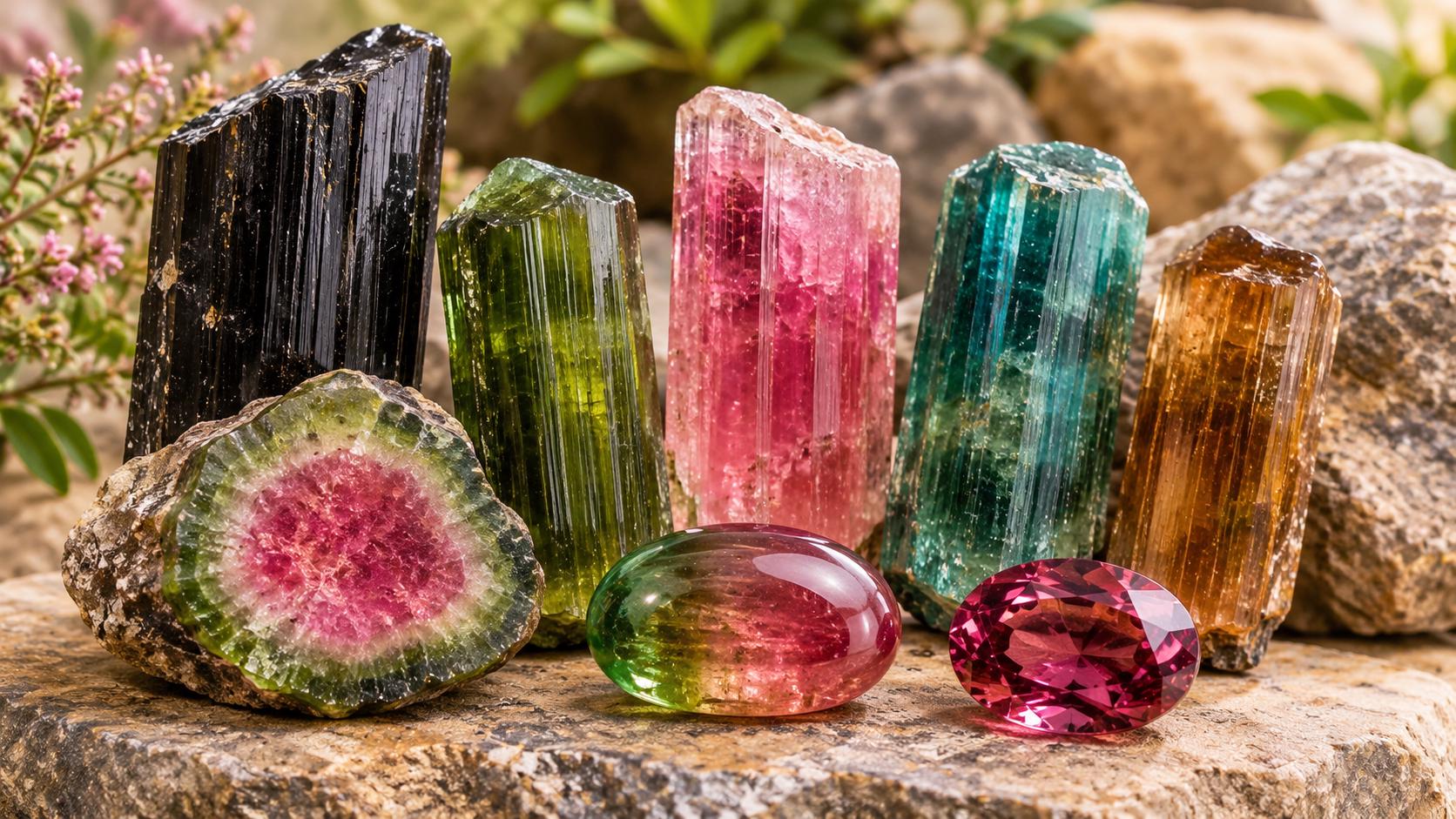
If crystals had a family reunion, tourmaline would be the relative who shows up wearing a different color every time! From deep forest green and electric blue to soft pink, fiery red, and classic black, tourmaline is one of the most visually diverse gemstone groups in the mineral world. Some specimens even contain multiple colors within a single crystal, creating natural patterns that look almost too beautiful to be real.
But tourmaline is more than a pretty collection of colors. Its unusual chemistry, fascinating geological origins, and even its ability to develop an electrical charge make it one of the most interesting minerals for collectors and geology enthusiasts.
What Exactly Is Tourmaline?
One important detail often overlooked is that tourmaline isn't actually a single mineral species. It is a group of closely related boron-bearing silicate minerals that share a similar crystal structure but differ in chemical composition.
The major species include elbaite, schorl, dravite, uvite, and liddicoatite. Their different chemical ingredients influence their physical properties and appearance.
Most gemstone-quality tourmaline belongs to the elbaite species, which is especially well known for its impressive variety of colors. Schorl, on the other hand, is typically black and is one of the most common forms encountered by mineral collectors.
Tourmaline generally has a Mohs hardness of 7 to 7.5, making it relatively resistant to everyday scratching, although it can still chip or fracture from impacts.
How Does Tourmaline Form?
Tourmaline is commonly associated with granite pegmatites, which are unusual igneous rocks formed during the later stages of magma cooling.
As granite magma cools, certain elements become concentrated in the remaining mineral-rich fluids. Boron is particularly important for tourmaline formation, and these chemically enriched environments can provide the ingredients needed for impressive crystal growth.
Pegmatites sometimes contain pockets where minerals have room to develop into large, well-formed crystals. These pockets can produce spectacular tourmaline specimens, occasionally displaying several colors within a single crystal.
Tourmaline also forms in metamorphic environments, particularly in rocks altered by heat, pressure, and chemically active fluids. This helps explain why the mineral occurs in so many different geological settings around the world.
A Rainbow of Tourmaline Varieties
Although tourmaline comes in numerous shades, several varieties have earned their own familiar names among collectors and gemstone enthusiasts.
- Schorl: The classic black variety, often found in long, vertically striated crystals. Black tourmaline is particularly popular in mineral collections and decorative carvings.
- Rubellite: A trade name used for pink, red, and reddish-purple tourmaline. Its shades range from soft rosy pink to rich raspberry and deep crimson.
- Indicolite: Blue to greenish-blue tourmaline, often prized for its beautiful ocean-like shades.
- Paraíba Tourmaline: A particularly sought-after copper-bearing variety known for intense neon-blue, turquoise, and greenish-blue colors. It was first discovered in Brazil's Paraíba state in the late 1980s. Copper-bearing material has since been found in other countries, including Nigeria and Mozambique.
- Watermelon Tourmaline: Perhaps one of the most playful varieties, this material displays pink in the center and green around the outside. When sliced across the crystal, the natural color zoning can resemble a tiny watermelon.
These names describe colors, varieties, or trade classifications rather than representing five additional mineral species.
The Science Behind Tourmaline's Electrical Properties
Here's where tourmaline gets particularly interesting!
Tourmaline displays two related physical properties called pyroelectricity and piezoelectricity.
Pyroelectricity means that a change in temperature can produce an electrical charge on the crystal's surface. Piezoelectricity means that mechanical pressure can produce an electrical charge.
These properties are connected to the mineral's internal crystal structure and the way its electrical charges are arranged.
Scientists have studied piezoelectric materials for many practical applications, including sensors and electronic components. Tourmaline's unusual properties helped make it historically interesting long before modern electronics existed.
Although these electrical effects are sometimes discussed in modern crystal-healing traditions, their scientific existence does not establish claims about healing energy or medical benefits.
Tourmaline Throughout History
The name tourmaline is believed to come from the Sinhalese word toramalli, meaning mixed gems. Dutch merchants used the term for colorful stones found in Sri Lanka's gem gravels.
Before modern mineral identification became established, tourmalines were sometimes mistaken for other gemstones because their colors could resemble emeralds, rubies, and sapphires.
Tourmaline also developed an important place in American gemstone history. Deposits in Maine and California became particularly significant during the late nineteenth and early twentieth centuries.
Pink and red tourmalines from California were exported to China, where craftsmen carved them into decorative objects and jewelry. The Chinese Dowager Empress Cixi was especially fond of the material, helping create an important international market for American tourmaline.
Today, tourmaline remains a popular October birthstone alongside opal.
Caring for Tourmaline
Tourmaline's hardness makes it suitable for many jewelry designs, but it isn't indestructible. Its toughness is considered fair, and sudden impacts or temperature changes can damage some specimens.
For jewelry and polished pieces, gentle cleaning with warm, soapy water and a soft cloth is generally recommended. Avoid steam cleaners and ultrasonic cleaners, as vibrations and heat can damage susceptible stones.
High heat can alter tourmaline's color, while sudden temperature changes can cause fractures. This is particularly important when dealing with specimens containing natural inclusions or known treatments.
When storing tourmaline jewelry, keep it separate from other pieces to prevent scratches and accidental impacts.
A Crystal Family Full of Surprises
Tourmaline is a wonderful reminder that nature doesn't need a paintbrush to create extraordinary colors and patterns. Its varied chemistry, unusual electrical properties, and fascinating geological origins make it much more than a beautiful gemstone.
Whether you're drawn to the dramatic appearance of black schorl, the delicate charm of pink rubellite, or the delightful color combinations of watermelon tourmaline, there's plenty to appreciate in this remarkable mineral family.
At Craven Crystals, we love exploring the science and stories behind the stones we collect and create with. Every specimen has something interesting to teach us, and tourmaline certainly brings a colorful collection of lessons. Take a look around our other crystal and mineral articles and discover what geological treasure catches your curiosity next!